There is a version of you that existed before the to-do lists, before the back-to-back meetings, before the kind of tiredness that sleep does not fix. You remember it vaguely. The version that woke up curious instead of anxious. That moved through a day without that low, constant hum of something being slightly wrong.
Most people spend years trying to find that version again through productivity apps, supplements, weekend getaways, gym memberships, and advice from podcasts listened to during commutes. Some of it helps for a few days. None of it lasts.
Karkidaka Chikitsa is not another thing to try. It is a completely different category of experience. And the reason it works is the same reason it has worked for over 5,000 years.
It starts with the rain.
Why the Body Knows Something You Have Forgotten
Kerala's monsoon is not background weather. In Ayurveda, it is a season with its own physiology.
When the rains arrive, the humidity rises and the air pressure changes. The skin's pores respond by opening. The body's channels, what Ayurveda calls the srotas, become more permeable. Medicated oils applied during this period absorb more deeply into the tissue than they would in a dry or hot month. The nervous system, no longer fighting heat and dehydration, settles into a state that is measurably calmer.
Simultaneously, Ayurveda identifies the monsoon as the season when digestive fire weakens. This is not a flaw. It is a physiological invitation to cleanse rather than consume, to reduce the load on the gut, to let the body's deeper systems do the work they have been waiting to do.
Karkidaka Chikitsa, the Ayurvedic healing protocol of the Malayalam month of Karkidaka, is designed to meet the body exactly here. At the moment when it is most open. Most receptive. Most ready.
This is not Ayurveda performed despite the weather. It is Ayurveda that uses the weather as medicine.
The Place Where the Mist Comes Down and Stays
Au Revoir Wellness Resort sits in the hills of Malampuzha, 12 kilometres from Palakkad town. You arrive and immediately understand that the location was not chosen for convenience or views, though the views are extraordinary. It was chosen because a place designed for healing should itself be a healer.
The resort was built around what was already there. The trees. The natural water features. The terrain of the hillside. Nothing was levelled to create a more manageable footprint. The mountain streams that run through the grounds are the same streams that were running there before the first stone was laid.
This matters more than it seems. The body heals faster when the nervous system feels genuinely safe. Not spa-safe, which is really just expensive-quiet. Actually safe. The kind that comes from being in a place that is not performing nature at you but simply existing as it always has.
When you walk the grounds in the early morning before your treatment, wet grass underfoot, mist in the canopy, birdsong doing the thing birdsong does when there is no traffic to compete with, something in you begins letting go before anyone has touched you.
The Consultation That Surprises Everyone
Most people arrive expecting to be handed a treatment list. A Monday-to-Sunday schedule with boxes to tick.
Dr. Chitra, Chief Physician at Au Revoir's treatment centre Vaidyam, does not work that way.
She sits with you. She takes your pulse in the Ayurvedic tradition, reading it at multiple positions and depths, each one corresponding to a different organ system and dosha balance. She looks at your tongue, your eyes, your skin. She asks about the quality of your sleep, not just the hours. About what time of day your energy drops and what it drops into. About where stress accumulates in your body and what it does when it gets there.
She is building a picture of your Prakriti, your unique constitutional makeup, the specific ratio of Vata, Pitta, and Kapha that makes your body yours and no one else's. This picture determines every treatment you receive, every herb that goes into the oils, every dietary adjustment made to your meals.
Guests who have been to other Ayurveda resorts consistently say the same thing after this consultation: that it was the first time in their wellness life that someone read their body rather than matched their symptoms to a menu.
The treatment plan that comes out of this conversation is yours. Genuinely yours. It is adjusted each day as Dr. Chitra monitors how you are responding, and it can change entirely if your body signals something unexpected. This is medicine, not hospitality.
What Abhyangam Actually Does
The word gets used so much in wellness marketing that it has started to feel familiar. Warm oil massage. Okay. Yes. And?
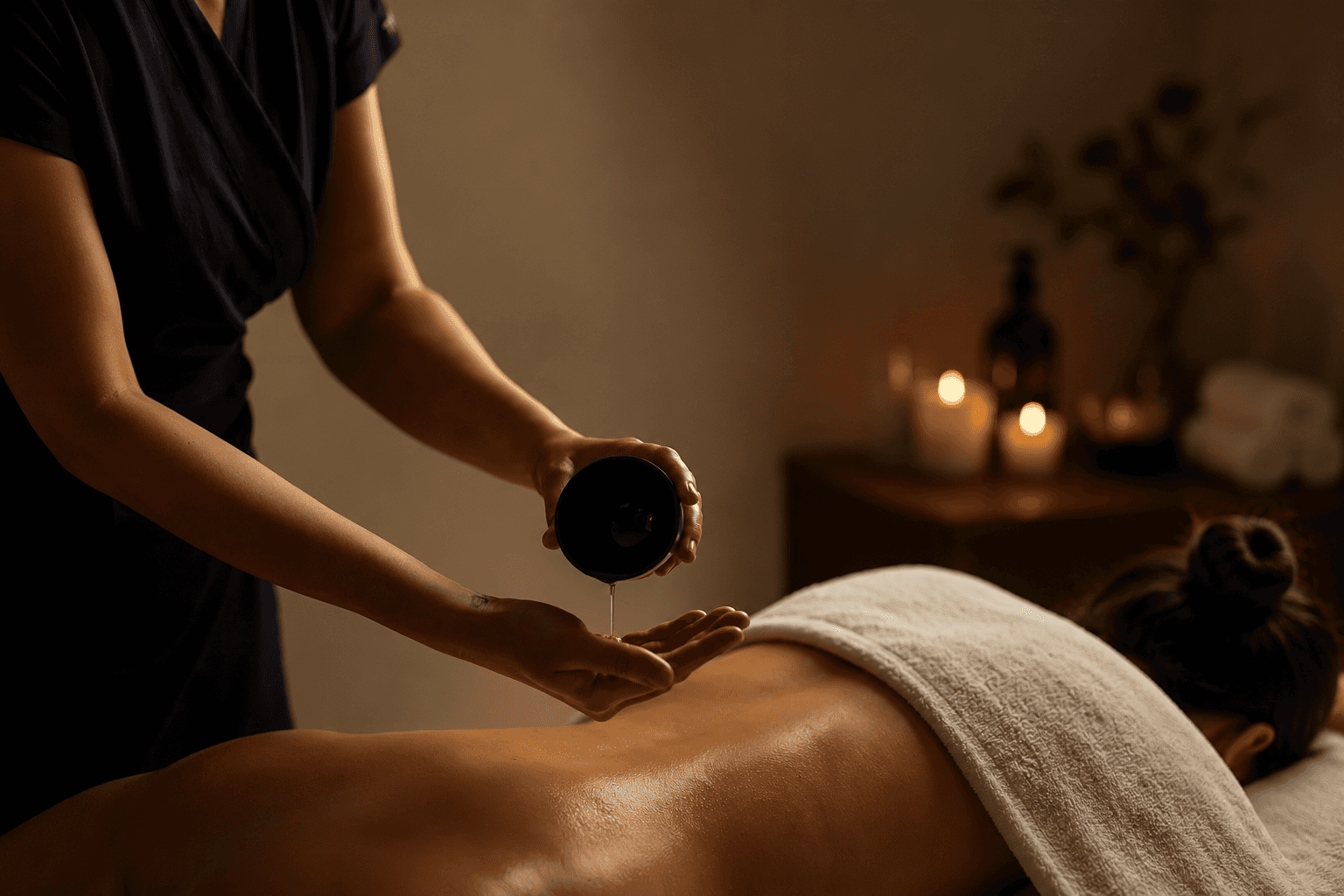
Here is what Abhyangam actually is when it is performed correctly, which means with two therapists working in synchronised movements, with oil specifically medicated for your dosha and your treatment goals, in a session that runs for ninety minutes without interruption.
The oil does not stay on the surface. Over ninety minutes, absorbed through increasingly open pores in monsoon humidity, it moves through the skin and into the subcutaneous tissue. Ayurveda describes it as reaching the seven dhatus, the tissue layers of the body, the outermost being skin and the deepest being bone marrow and reproductive tissue. Modern pharmacokinetics confirms that fat-soluble compounds in the medicated oils cross the dermal barrier and enter systemic circulation.
What this means in practice is that the oils are not moisturising you. They are moving toxins, what Ayurveda calls Ama, from the deeper tissue toward the digestive tract and the body's elimination pathways, where the dietary and herbal components of the programme will carry them out.
The reason you feel heavy and simultaneously light after Abhyangam is not relaxation. It is biological process.
Sirodhara and the Mind That Would Not Quiet
Many people arrive at Au Revoir carrying a specific kind of exhaustion. Not physical. Mental. The relentless commentary that runs in the background regardless of what the body is doing. The planning, the replaying, the low-grade anxiety that has been running so long it no longer registers as anxiety, just as normal.
Sirodhara is prescribed for this.
A thin, continuous stream of warm medicated oil is poured across the forehead from a suspended vessel, moving in a gentle pendulum arc, for thirty to forty-five minutes. The temperature is precise. The oil is specific to your condition.
The mechanism by which Sirodhara works is still being studied by neuroscientists, and several theories exist around its effect on the hypothalamic-pituitary axis and the trigeminal nerve pathways. What is agreed, experientially and increasingly clinically, is that it produces a state of mental quiet that most subjects have not been able to access through any other means.
You do not fall asleep. You do not think. You exist in the interval between the two, and when it ends you lie still for a while because moving feels unnecessary.
People who have had insomnia for years sleep through the night after Sirodhara. People who have been in a state of low-level cortisol elevation for so long it felt like personality describe a stillness that feels unfamiliar and correct at the same time.
The Food Is Not a Concession to Your Healing. It Is Part of It.
Au Revoir's kitchen for wellness guests is entirely separate from any other food preparation at the resort. Different kitchen. Different utensils. Different equipment. This is not a labelling exercise. It is a structural commitment to something the resort takes seriously enough to build into its physical infrastructure.
Every meal is calibrated to the monsoon season, to your dosha, and to the specific phase of your treatment programme. Early in the programme, the diet supports the opening and loosening phase of detoxification. As treatments progress and the body moves into elimination and rebuilding, the meals shift accordingly.
The Karkkidaka Kanji that arrives each morning is the most obvious expression of this. A medicinal herbal porridge prepared fresh daily, using formulations rooted in classical Ayurvedic texts and specific to the Karkidaka season. It is designed to rebuild Agni, the digestive fire, gently and progressively. It is one of the oldest healing foods in Kerala and it is not available anywhere outside this seasonal context.
The afternoon or evening meal from the Ayurvedic menu is not restricted food. It is food that has been designed to work in concert with what was applied to your body on the treatment table that morning. The distinction sounds small. The effect is significant.
The Moments That Do Not Appear in the Treatment Schedule
The activities woven through the programme are easy to underestimate from a description. Floral art. A cooking class. Planting a sapling. These sound like the kind of resort programming that exists to fill afternoons.
They are not.
The walking meditation through the forested grounds of the resort, called Roots, operates on a principle that Japanese researchers have spent considerable effort studying. Forest bathing, the science underlying the practice, shows measurable reductions in cortisol, improvements in natural killer cell activity, and reductions in blood pressure following time spent in forested environments. The walking meditation at Au Revoir does not explain this to you. It simply walks you through the trees and lets the trees do what trees have always done to human nervous systems.
The sapling-planting on Day 5 is the one that guests mention most unexpectedly. It is five minutes of physical action in the soil of Malampuzha. You press a living thing into the ground and walk away leaving it there. Something about the smallness of it, the simplicity, the fact that it will keep growing long after you have gone back to your life, lands differently than its description suggests it should.
What Happens When You Leave
The effects of Karkidaka Chikitsa are not a retreat high. They are not the temporary lightness of a good holiday that fades on the drive back to the city.
The detoxification that happens across the eight days is cellular. The oils have moved through the tissue. The herbal formulations have worked through the digestive and elimination systems. The Agni has been rebuilt. The nervous system has experienced, perhaps for the first time in years, what genuine rest feels like.
What most guests notice in the weeks after returning is a change in their baseline. Sleep is deeper and more regular. Digestion is more settled. The cognitive noise is quieter. Joint stiffness that was accepted as permanent is reduced or gone. And there is a quality of physical lightness, not weight loss, but a different relationship between the body and the effort of occupying it, that is difficult to describe and easy to notice.
Ayurveda would describe this as the restoration of Ojas, the deepest vitality of the body, the thing that is depleted by chronic stress and poor digestion and accumulated toxin and restored through correct treatment at the correct time.
The correct time is now. The monsoon does not reschedule.
Before You Go
Au Revoir Wellness Resort is in Malampuzha, Palakkad, Kerala. 12 km from Palakkad town. Surrounded by forested hills and mountain streams. Fully non-alcoholic. Fully non-smoking. Completely vegetarian kitchen for wellness guests. Treatment led by Dr. Chitra, Chief Physician, and the Vaidyam team.
The Karkidaka Chikitsa programme runs for 7 nights and 8 days. It begins before you arrive with an online consultation with Dr. Chitra. It ends with a farewell dinner and a Sound Bath and the particular feeling of a body that has been genuinely heard.
The 2026 season is open now.
How is this different from a regular spa or wellness retreat?
A spa addresses symptoms at the surface. Karkidaka Chikitsa is a medically supervised detoxification and rebuilding protocol. Treatments are prescribed individually, not selected from a menu. The effects are systemic and cumulative. The programme is led by a qualified physician, not a wellness consultant.
What if I have an existing health condition?
The pre-arrival consultation with Dr. Chitra is the place to discuss this. The programme is adapted to individual health needs and some conditions may require specific modifications or medical clearance. Reach out before booking so the team can advise you properly.
Why does the programme need to happen during the monsoon?
Because the monsoon is not just timing. It is a physiological condition that makes the treatments significantly more effective. The seasonal alignment is part of the therapeutic mechanism, not incidental to it. Karkidaka Chikitsa performed outside the monsoon is a different and less potent experience.
What should I do to prepare before arriving?
The pre-arrival consultation with Dr. Chitra will give you specific guidance based on your health profile. In general, reducing alcohol, processed food, and heavy meat consumption in the week before arrival gives the programme a cleaner starting point. Arrive rested if possible, though many guests arrive depleted and the programme meets them there without judgment.
Is this suitable if I have never done Ayurveda before?
Yes. The pre-arrival consultation and daily monitoring are specifically designed to make the experience accessible and well guided for first-time guests. Many guests say the explanation behind each treatment is what made it different from anything they had tried before.
